Music Boxes: A 200-Year Journey from Swiss Craftsmanship to Modern Collectibles
Jan 25,2025 | FunSpace
It carries romance and tenderness, and preserves happiness and memories. The development of music boxes accompanies the changes of the times, and also reflects the perfect combination of aesthetics and practicality. Open it and listen to the song of time, close it and quietly collect time. Let us follow the footsteps of music, spanning a century of music, and uncovering its past and present.
📜The history of music boxes, also known as music boxes, can be traced back to the Renaissance in medieval Europe. At that time, church bell towers needed to tell time, so people invented "sound-generating bells" of different sizes equipped with mechanical devices. This is the prototype of the music box. By the 14th century, church bell towers became another early form of music box, which played clear music through clockwork devices and became popular.
🎶Over time, music boxes have undergone significant changes in both technology and appearance. Around 1780, Swiss composer Jean-Paul Lavandou was inspired by the principle of the puppet automatic clock and invented a mechanical bird-singing clock. In 1796, Geneva clockmakers brought about a revolutionary change. They reduced the size of the music box to the limit. In the same year, Swiss watchmaker Antoine Fabre developed the cylindrical music box, which was the largest in the world. One of the oldest music boxes, it has become a treasure in antique collections.
🎶In the 19th century, the technology for making music boxes developed further. Symphonion, a Leipzig-based manufacturer of disc-type symphonic music cabinets, customized disc-type music boxes for luxury stores in Vienna, marking that music boxes had become a high-end luxury product. In the 20th century, especially after World War II, with the spread of technology and the reduction of costs, music boxes gradually became popular and became a popular musical toy and decoration worldwide.
🎉It is worth mentioning that in 1992, Ningbo Yunsheng in China produced the first music box with independent intellectual property rights, which marked a major breakthrough for China in the field of music boxes. Since then, China's music box manufacturing industry has developed rapidly and has become an important player in the global music box market.
As music boxes have evolved, their movement technology has also continued to improve. The movement is the core component of the music box, which consists of a sound cylinder, soundboard, gears, spring, damping, etc. With the innovation of technology, the number of notes on music boxes has gradually increased, from the original 8 notes to 18 notes, 30 notes, 50 notes, 78 notes and even 156 notes. The more scales there are, the wider the range of the songs played and the more timbre. full.
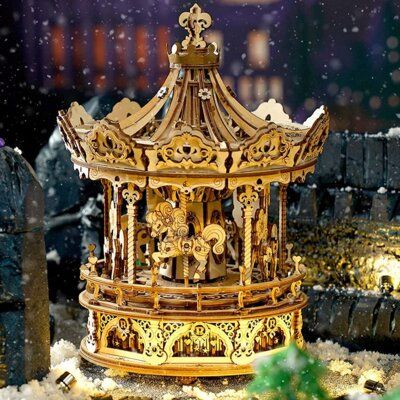
🕰️It is a witness to history and records creativity
From the initial mechanical clock set to the small and exquisite music box, and then to the later music boxes with increasing number of notes and richer timbre, behind all of this are the results of the unremitting efforts of countless craftsmen and designers. With their ingenuity and skillful hands, they have made the music box not just a gadget that can produce beautiful melodies, but also a work of art that carries historical memory and cultural charm.
Moreover, music boxes also witness the communication and integration between different cultures. It spread from one place to another, combined with local culture, and formed a unique style. It is like the music box is a small boat in the long river of history, carrying people's creativity and wisdom, constantly sailing and exploring, leaving behind beautiful ripples.
Therefore, a music box is not just a small box that can make sounds, it is more like a thick history book that records people’s creativity, wisdom and pursuit of a better life! And you? Do you also think music boxes are magical?
Comment